
CLINICALLY VALIDATED · ORAL-HEART WELLNESS
Prebiotic Nitric Oxide Test Strips
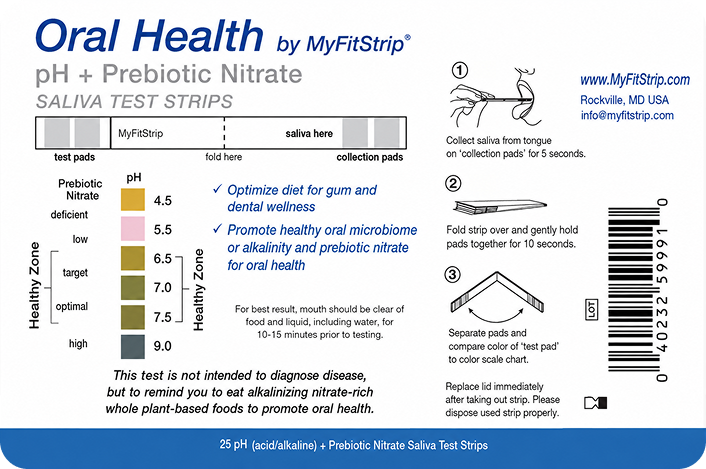
Saliva pH + Prebiotic Nitrate Test Strips
Plant-derived nitrate is a critical prebiotic for both oral & heart wellness.

THE SCIENCE
What's your saliva prebiotic nitrate?
A healthy oral microbiome is rich in certain types of nitrate-reducing bacteria that improves oral health.
Inorganic nitrate — abundant in dark leafy greens and beets — is a prebiotics that encourages health-promoting bacteria to grow on our tongue.
Clinical studies found that prebiotic inorganic nitrate decrease the disease-associated oral bacteria that cause cavities, halitosis or bad breath, and gum disease and periodontitis.
Dietary prebiotic nitrate
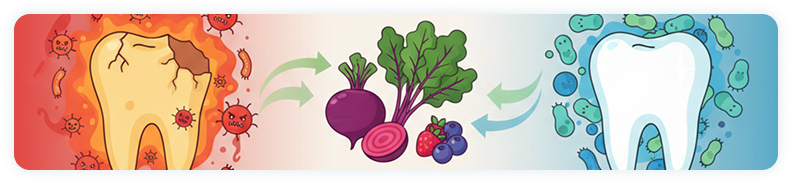
Dietary prebiotic nitrate shifts your oral microbiome from acid-promoting & tooth decaying to cavity-fighting bacteria.
Diets rich in prebiotic nitrate reduce cavity-causing acid, eliminate bad breath, and improving gum health.
Dietary nitrates were also found to decrease the production of lactic acid in the mouth and increase the mouth’s pH to become more alkaline or basic (not acidic), which helps reduce the risk of developing cavities, caused by acid-promoting bacteria.
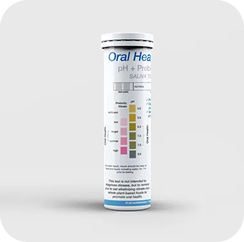
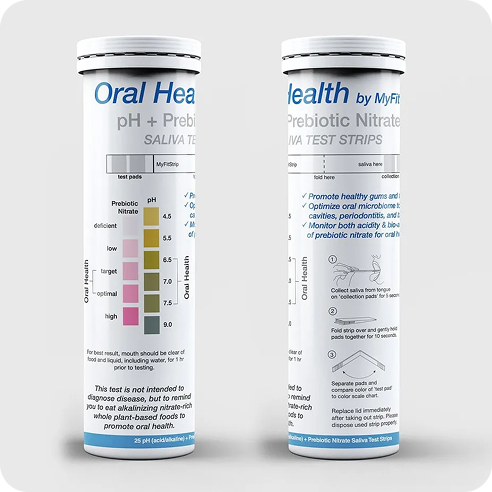
Oral Health pH + Prebiotic Nitrate Saliva Test Strips by MyFitStrip is not intended to diagnose disease, but to remind you to eat alkalinizing nitrate-rich whole plant-based foods to promote oral health.
test strip
ORAL HEALTH pH + Prebiotic Nitrate Saliva Test Strip by MyFitStrip is an easy-use, 10-second, non-invasive, patent-pending saliva test strips to:
- Optimize your diet for gum and dental health
- Promote healthy oral microbiome
- Monitor alkalinity and prebiotic nitrate for oral health
CLINICALLY VALIDATED ORAL MICROBIOME
Is your mouth acidic?
Or is it alkaline and Prebiotic nitrate-rich?
Check with MyFitStrip?
A healthier oral environment starts with nitrate
Clinical studies now support the notion that a nitrate-rich diets can help prevent oral disease. Children with a higher abundance of nitrate-reducing bacteria in the oral cavity were better able to reduce nitrate and were significantly less likely to have tooth decay.
Nitrate supports a healthier oral microbiome
Matter of fact, both adults and children with higher salivary nitrate and nitrite have a lower incidence of tooth decay or dental caries. And the oral health benefits extend beyond tooth decay. For example, nitrate-rich lettuce juice increased the abundance of nitrate-reducing bacteria, Rothia and Neisseria and decreased gingival inflammation in periodontal patients.
A healthy mouth needs the right pH
Prebiotic nitrate also increases the pH of saliva. Cavity promoting bacteria degrade sugars from the diet resulting in strong acids. Salivary pH sustained below 5.5 can cause de-mineralisation of the teeth resulting in tooth decay. A number of labs have now confirmed that nitrate-rich beetroot juice prevents the decline in salivary pH following ingestion of sugar-rich beverages and foods. Nitrate can acutely limit acidification when sugars are fermented in saliva, which appears to result from lactate usage by nitrate-reducing bacteria.
Check your oral environment
To prevent tooth decay and keep gums health, we need nitrate-rich plant-based natural foods to shift our oral microbiome.
You can now check for both dietary prebiotic nitrates and the corresponding nitrate-reducing oral microbiome with MyFitStrip, the next generation saliva nitric oxide test strip and pH + prebiotic nitrate test strips.
THE PRODUCT
ORAL HEALTH pH + Prebiotic Nitrate Saliva Test Strips by MyFitStrip
Start your day with a 10-second test.
If acidic and nitrate deficient, eat prebiotic nitrate-rich natural, plant-based foods, and test again 2 hours later.

wellness
Wellness Is Personal
Within 10-seconds of testing, MyFitStrip will detect whether dietary prebiotic nitrate from your plant-based foods are present to maintain oral health.
Testing is easy and results are instant. Keep your breath fresh, teeth strong, and gums healthy.
Questions
Frequently Asked Questions
Still have questions? Our science team is ready to help.
Clinical evidence now suggests that dietary nitrate supplementation improves poor oral health via shifting the oral microbiome to a nitrate-reducing microbiome from a bacterial species that are commonly associated with oral diseases such as periodontitis and tooth decay or dental caries.
Salivary nitric oxide test strips typically measure for nitrite which is produced by the nitrate-reducing bacteria found on tongue. This is a critical initial step in the formation of nitric oxide, since nitrite is subsequently converted to nitric oxide. However, prebiotic nitrate test strips measures for the prebiotic nitrate, directly, a critical starting point to this protective pathway for both oral and cardiovascular health.
Prebiotic nitrate increases the pH of saliva. Tooth decaying or caries promoting bacteria degrade sugars from the diet resulting in strong acids. Salivary pH, ideally, should be in the pH range from 6.7 to 7.2. However, sugary beverages and diets can cause a acidic saliva or a drop in the pH. Unfortunately, pH sustained below 5.5 -- after drinking sugary drinks -- can cause de-mineralisation of the teeth resulting in tooth decay.
A number of labs have now confirmed that nitrate-rich beetroot juice prevents acidic saliva or the decline in salivary pH following ingestion of sugar-rich beverages and foods. Nitrate can limit acidification when sugars are fermented in saliva, which appears to result from lactate usage by nitrate-reducing bacteria.
Oral Health pH + prebiotic nitrate test strips by MyFitStrips provides immediate feedback to optimize your alkalinizing diet.
Similar to our gut, our mouths contain a mix of good and bad bacteria. Having a 'healthy microflora' on our tongue that converts dietary prebiotic nitrate to nitrite is critical in restoring oral health. Eradication of oral nitrate-reducing bacteria through antiseptic mouthwash, such as chorhexidine, or overuse of antibiotics can result in oral and dental problems.
Studies have found that increased dietary intake of inorganic nitrate shifted the oral microflora to a richer population of nitrate-reducing bacteria with improvements in oral and cardiovascular health.
There is extensive evidence to support the notion that a nitrate-rich diet can help prevent oral disease. Children with a higher abundance of nitrate-reducing bacteria in the oral cavity were better able to reduce nitrate and were significantly less likely to have tooth decay.
Matter of fact, both adults and children with higher salivary nitrate and nitrite have a lower incidence of tooth decay or dental caries. The oral health benefits extend beyond tooth decay. For example, nitrate-rich lettuce juice increased the abundance of nitrate-reducing bacteria, Rothia and Neisseria and decreased gingival inflammation in periodontal patients.
Learn more
Clinical Studies
1
Vanhatalo A, et al.
Nitrate-responsive oral microbiome modulates nitric oxide homeostasis and blood pressure in humans.
Free Radic. Biol. Med., 124 (2018), pp. 21-30
2
Velmurugan S et al.
Dietary nitrate improves vascular function in patients with hypercholesterolemia.
Am. J. Clin. Nutr., 103 (2016), pp. 25-38
3
Rosier BT, et al.
Nitrate as a potential prebiotic for the oral microbiome.
Sci. Rep., 10 (2020), 12895
4
Rosier BT et al.
A single dose of nitrate increases resilience against acidification.
Front. Cell. Infect. Microbiol., 11 (2021), p. 483
5
Govoni M, Jansson EA, Weitzberg E, Lundberg JO.
The increase in plasma nitrite after a dietary nitrate load is markedly attenuated by an antibacterial mouthwash.
Nitric Oxide, 19 (2008), pp. 333-337
6
Bescos, R A. Ashworth, C. Cutler, Z.L. Brookes, L.
Belfield, A. Rodiles, P. Casas-Agustench, G. Farnham, L. Liddle, M. Burleigh, D. White, C. Easton, M. Hickson. Effects of Chlorhexidine mouthwash on the oral microbiome.
Sci. Rep., 10 (2020), p. 5254
7
Babateen AM, Shannon OM, Mathers JC, Siervo M.
Validity and reliability of test strips for the measurement of salivary nitrite concentration with and without the use of mouthwash in healthy adults.
Nitric Oxide, 91 (2019), pp. 15-22
8
Hegde M, N.D. Hegde ND, Ashok A, Shetty S.
Salivary nitric oxide (NO¬2+NO3) as a biomarker of dental caries in adults- an in vivo study. Int. Res. J.
Pharm., 3 (2012), pp. 100-102
9
Jockel-Schneider Y, et al.
Stimulation of the nitrate-nitrite-NO-metabolism by repeated lettuce juice consumption decreases gingival inflammation in periodontal recall patients: a randomized, double-blinded, placebo-controlled clinical trial J. Clin.
Periodontol., 43 (2016), 10.1111/jcpe.12542
10
Lundberg JO, Govoni M.
Inorganic nitrate is a possible source for systemic generation of nitric oxide. Free Radic.
Biol. Med., 37 (2004), pp. 395-400
11
Rosier BT et al.
Isolation and characterization of nitrate-reducing bacteria as potential probiotics for oral and systemic health Front.
Microbiol., 11 (2020), 10.3389/fmicb.2020.555465
12
Doel JJ, et al.
Protective effect of salivary nitrate and microbial nitrate reductase activity against caries Eur. J.
Oral Sci., 112 (2004), pp. 424-428
13
Webb AJ, Patel N, Loukogeorgakis S, Okorie M, Aboud Z, Misra S, Rashid R, Miall P, Deanfield J, Benjamin N, MacAllister R, Hobbs AJ, Ahluwalia A.
Acute BP Lowering, Vasoprotective, and Antiplatelet Properties of Dietary Nitrate via Bioconversion to Nitrite.
Hyperten. 2008 Mar;51(3):784-90. Epub 2008 Feb 4.
14
Wink DA, Paolocci N.
Mother Was Right: Eat Your Vegetables and Do Not Spit! When Oral Nitrate Helps With High BP.
Hyperten. 2008 Mar;51(3):617-9. Epub 2008 Feb 4.
15
Liddle L, Burleigh MC, Monaghan C, Muggeridge DJ, Sculthorpe N, Pedlar CR, Butcher J, Henriquez FL, Easton C.
Variability in nitrate-reducing oral bacteria and nitric oxide metabolites in biological fluids following dietary nitrate administration: An assessment of the critical difference.
Nitric Oxide. 2019 Feb 1;83:1-10.
16
Burleigh MC, Liddle L, Monaghan C, Muggeridge DJ, Sculthorpe N, Butcher JP, Henriquez FL, Allen JD, Easton C.
Saliva nitrite production is elevated in individuals with a higher abundance of oral nitrate-reducing bacteria.
Free Radic Biol Med. 2018 May 20;120:80-88.
17
Woessner M, Smoliga JM, Tarzia B, Stabler T, Van Bruggen M, Allen JD.
Stepwise reduction in plasma and salivary nitrite with increasing strengths of mouthwash following a dietary nitrate load.
Nitric Oxide. 2016 Apr 1;54:1-7.
18
Govoni M, Jansson EA, Weitzberg E, Lundberg JO.
The increase in plasma nitrite after a dietary nitrate load is markedly attenuated by an antibacterial mouthwash.
Nitric Oxide. 2008 Dec;19(4):333-7.
19
Jonvik KL, Nyakayiru J, Pinckaers PJ, Senden JM, van Loon LJ, Verdijk LB.
Nitrate-Rich Vegetables Increase Plasma Nitrate and Nitrite Concentrations and Lower BP in Healthy Adults.
J Nutr. 2016 May;146(5):986-93.
20
McDonagh STJ, Wylie LJ, Webster JMA, Vanhatalo A, Jones AM.
Influence of dietary nitrate food forms on nitrate metabolism and BP in healthy normotensive adults.
Nitric Oxide. 2018 Jan 30;72:66-74.
21
Hohensinn B, Haselgrübler R, Müller U, Stadlbauer V, Lanzerstorfer P, Lirk G, Höglinger O, Weghuber J.
Sustaining elevated levels of nitrite in the oral cavity through consumption of nitrate-rich beetroot juice in young healthy adults reduces salivary pH. .
Nitric Oxide. 2016 Nov 30;60:10-15
22
Govoni M, Jansson EA, Weitzberg E, Lundberg JO.
The increase in plasma nitrite after a dietary nitrate load is markedly attenuated by an antibacterial mouthwash.
Nitric Oxide. 2008 Dec;19(4):333-7. Epub 2008 Aug 30.
23
LJ Wylie, J Kelly, SJ Bailey, JR Blackwell, PF Skiba, PG Winyard, AE Jeukendrup, A Vanhatalo, AM Jones.
Beetroot juice and exercise: pharmacodynamic and dose-response relationships.
J Appl Physiol (1985). 2013 Aug 1;115(3):325-36.
24
NF Hord, Y Tang, NS Bryan.
Food sources of nitrates and nitrites: the physiologic context for potential health benefits.
Am J Clin Nutr. 2009 Jul;90(1):1-10.
25
S Lidder, AJ Webb.
Vascular effects of dietary nitrate (as found in green leafy vegetables and beetroot) via the nitrate-nitrite-nitric oxide pathway.
Br J Clin Pharmacol. 2013 Mar;75(3):677-96.
26
T D Presley, A R Morgan, E Bechtold, W Clodfelter, R W Dove, J M Jennings, R A Kraft, S B King, P J Laurienti, W J R ejeski, J H Burdette, D B Kim-Shapiro, G D Miller.
Acute effect of a high nitrate diet on brain perfusion in older adults.
Nitric Oxide. 2011 Jan 1;24(1):34-42.
27
V Kapil, R S Khambata,
A Robertson, M J Caulfield, A Ahluwalia. Dietary nitrate provides sustained BP lowering in hypertensivepatients: a randomized, phase 2, double-blind, placebo-controlled study.
Hyperten. 2015 Feb;65(2):320-7.
28
M P Hezel MP, Weitzberg E.
The oral microbiome and nitric oxide homoeostasis.
Oral Dis. 2015 Jan;21(1):7-16.